


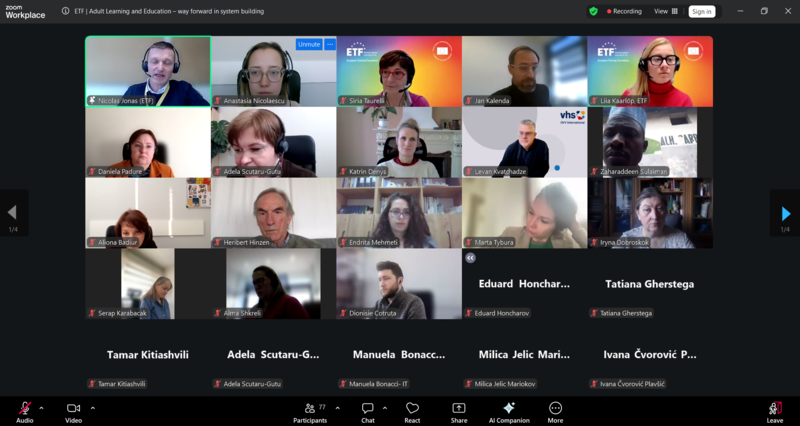

The year 2026 started with a regional webinar on 20 January 2026, hosted by the European Training Foundation (ETF) in collaboration with DVV International. The webinar was titled “Adult Learning and Education – way forward in system building”.
The event brought together 93 stakeholders from the field of adult learning and education (ALE), representing EU Member States, candidate countries, and neighbouring countries. The webinar aimed to reflect on an important question: How can countries develop Adult Learning Systems (ALS) that simultaneously raise participation and reduce inequality?
The webinar's key contributions came from Jan Kalenda, representative of Tomas Bata University in the Czech Republic, and Jasna Jovanovic, Director General at the Ministry of Education, Science and Innovation, Montenegro.
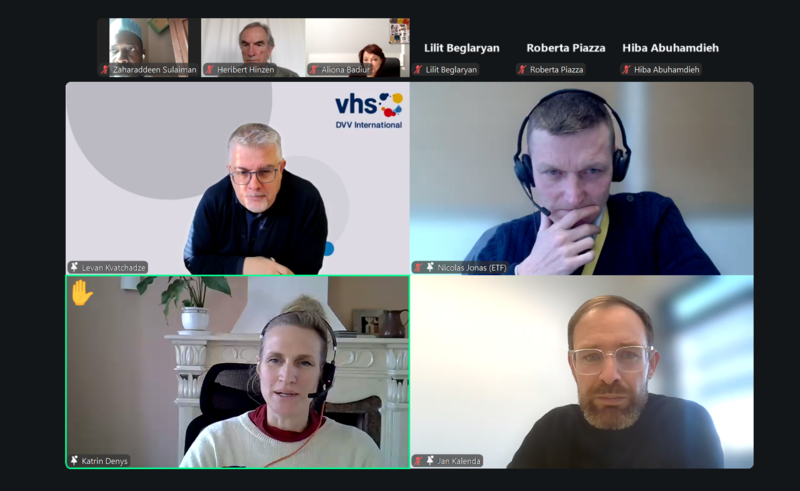
Nicolas Jonas, Human Capital Development Expert at ETF, made the introduction to the first speaker.
Mr Jan Kalenda proposed a three-layer governance architecture of ALS comprising legislation, strategic planning and financing. A coherent legal framework creates the necessary environment for ALE development, while strategy aligns directions of action and proper financing ensures its realisation. In his speech, Kalenda discussed good practices related to these pillars, as well as frequent challenges that should be addressed. The legislation pillar inquires a clear division of responsibilities between ministries, formal recognition of different types of ALE (including informal and non-formal), and a rights-based approach, while policy fragmentation, over-prioritisation of formal education, and keeping policies at a theoretical level are among the main challenges. The characteristics of strong strategies are evidence-based orientation, explicit key indicators, prioritisation of diversity among adult learners, consideration of long-term outcomes, and a multisectoral perspective. Frequent changes and undervaluing quality to achieve high quantitative indicators lead to weak strategies. Regarding the financing pillar, the expert considers multi-source allocation the most sustainable approach, based on public funding, employer fees, individual payments, and international grants as drivers of development. Short-term, project-based approaches are considered ineffective.
Ms Jasna Jovanovic shared with the audience the successful story of ALE development in Montenegro. The country’s government prioritised the domain and developed strong policies, which resulted in innovative solutions addressing the needs of all, especially vulnerable citizens. Practices such as micro-credentials for courses responding to labour market needs, regular revision of course providers, maintaining monitoring data through a central educational data system, and promotion of ALE opportunities at the national level created strong premises for ALE development and consequently led to significant improvement in human capital. It is worth acknowledging that the country’s government played an important role in policymaking, ensured that strategies were realistic, and took the necessary responsibility for financial sustainability. The experts participating in the webinar agreed that the key to Montenegro’s success is strong and systemic policymaking combined with the dedication of a central authority.
Participants actively engaged in the webinar during the Q&A session moderated by Nicolas Jonas (ETF) and Levan Kvatchadze (DVV International). The questions related to strategy quality indicators, career guidance measures in Montenegro, the role of EU accession in development progress, methods for reaching vulnerable groups, and the role of civil society in delivering long-term outcomes.
Finally, Siria Taurelli (ETF) summarised the main webinar outputs:
ALE stakeholders tend to underestimate the role of systems in providing sustainable ALE outcomes; however, coordination and steering planning should be prioritised.
Resources should be allocated for the coordination of ALE activities, and market logic based on demand does not work in the long term.
A proper system is based on legislation, planning, and dedicated financing.
Government intention is crucial to support ALE, as demonstrated by the case of Montenegro.
EU candidate countries should include ALE in their growth and investment plans to anchor reforms in the domain.
Thus, high participation and low result from how multiple components of the system work together over time. In this perspective, a coherent architecture encompassing the legislative framework, strategic planning provisions and financing mechanisms is critical. These foundational axes should moreover lay the ground for coordination and responsibility sharing among stakeholders. These foundational axes should establish the basis for coordination and the sharing of responsibility among stakeholders.