


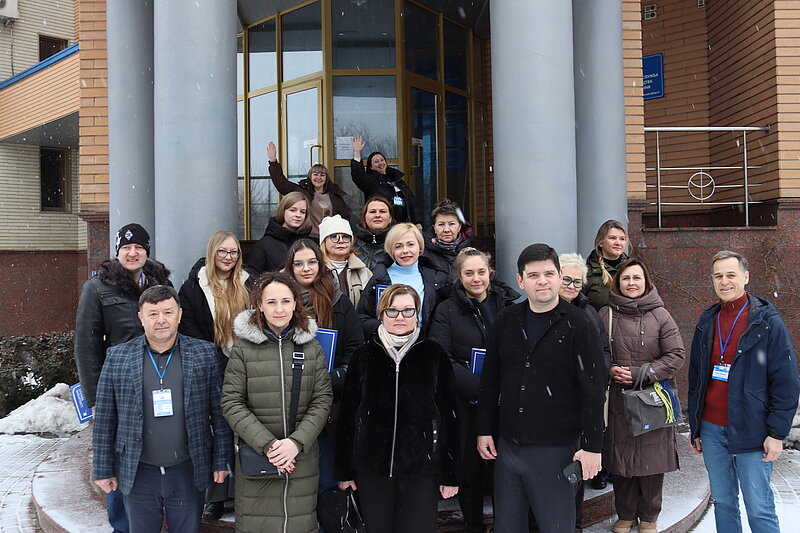
On February 24-25, the first National Meeting of the UNESCO Learning Cities Network in Ukraine was held in Ternopil. The event was initiated by the National Commission of Ukraine for UNESCO, the UNESCO Institute for Lifelong Learning (UIL), the UNESCO Office in Ukraine, and the DVV International Representative Office in Ukraine.
The first day started with the official opening and a session, titled “Identity, Shared Principles and Learning Based on Urban Strategies.” Participants outlined the mission of the Network and its role in aligning municipal lifelong learning strategies within a unified national learning ecosystem.
Welcome remarks were delivered by the invited representatives of the Parliament of Ukraine, the Ternopil city authorities, the National Commission of Ukraine for UNESCO, the UNESCO Office in Ukraine, and the DVV International Office in Ukraine. The Mayor of Ternopil, Ihor Hirchak, emphasized the importance of supporting education during wartime and highlighted the role of communities in ensuring continuity of learning. Yaroslavа Levchenko, representative of the Verkhovna Rada Committee on Education, Science and Innovation, noted that wartime challenges stimulate the development of adult education. Nina Kramareva, First Secretary of the Secretariat of the National Commission of Ukraine for UNESCO, wished participants fruitful cooperation and the development of new partnerships and horizontal connections based on initiative and mutual support. She also underlined that the Ukrainian Network of Learning Cities has the potential to become a role model for the Global Network of Learning Cities. Alyona Popova, Education, Mental Health and Psychosocial Support Specialist at the UNESCO Office in Ukraine, welcomed the participants and thanked the Ternopil City Council and its Department of Education and Science for hosting and organizing the meeting. Oleg Smirnov, Director of the DVV International Representative Office in Ukraine, expressed gratitude to UNESCO for actively promoting Ukrainian cities within the Global Network of Learning Cities and stressed the strong demand for adult education development in Ukraine.
A separate session focused on reviewing urban strategies and holding an open dialogue among community representatives on the topic “What unites us as a network?” Cities that had already developed lifelong learning strategies or targeted programs presented their experience. Representatives from Ternopil, Vinnytsia, Melitopol, Lviv, Poltava, Nikopol, and Sumy shared their approaches to designing and implementing adult education programs, highlighting key challenges, achievements, and future prospects.
The second part of the day featured a practical demonstration of the Lifelong Learning Strategy of the Ternopil City Territorial Community. Participants joined the interactive tour “Navigation of Opportunities and the Learning Ecosystem,” which showcased real tools and initiatives already functioning in the community. The demonstration took place across eight locations, each presenting different types of educational activities.
Ukrainian organizations also shared their approaches to lifelong learning. The NGO “Svit Hromad” introduced modern game-based learning methods for adults. The “Initiative” Club presented youth educational start-ups aimed at developing entrepreneurial and communication skills. Participants learned about the “Slovo” speaking club for internally displaced persons, which supports language adaptation and social integration, as well as the psychological support program “How Are You?” for vulnerable groups. The interactive part concluded with the workshop “Unique Business Merch,” where participants created their own products.
The program also included a fashion show, “Identity: From Authenticity to the Modern Ukrainian City,” highlighting the continuity from traditional clothing that preserves national identity to contemporary interpretations suited to today’s urban environment, followed by a plenary session on “Coordination and Network Management.” The day concluded with a visit to the “Accessible Heritage” Library Ethno-Center, demonstrating the library’s role as a modern community learning space.
On February 25, the meeting continued in a practical format under the theme “Activities within the Network Framework.” Participants visited the Employment Center to explore tools of economic inclusion as part of lifelong learning and discussed how educational programs can support rapid adaptation to labor market changes and the integration of vulnerable groups. They also visited the University of the Third Age to review models of learning for older adults.
Thematic sessions focused on the role of cities in promoting social cohesion and inclusive recovery, integrating lifelong learning into social protection policies, and strengthening links between municipal strategies and the national adult education agenda. Special attention was given to positioning the Ukrainian Network in the international context, particularly within UNESCO and the Global Network of Learning Cities.
An important part of the second day was a visit to three rehabilitation centers for military personnel, where participants learned about psychological support, professional adaptation, and training programs for veterans.
The meeting concluded with the official confirmation of the launch of the National UNESCO Learning Cities Network in Ukraine. Participants summarized the results, agreed on priority steps for cooperation, and reaffirmed their commitment to developing the Network as a platform for horizontal interaction, experience exchange, and coordinated action.
The first National Meeting of the Network in Ukraine has become a platform for meaningful professional dialogue and exchange of approaches to lifelong learning. It demonstrated that Ukrainian communities are ready not only to implement lifelong learning locally but also to act as a united community capable of shaping policy, supporting one another, and integrating Ukrainian experience into the global context.