


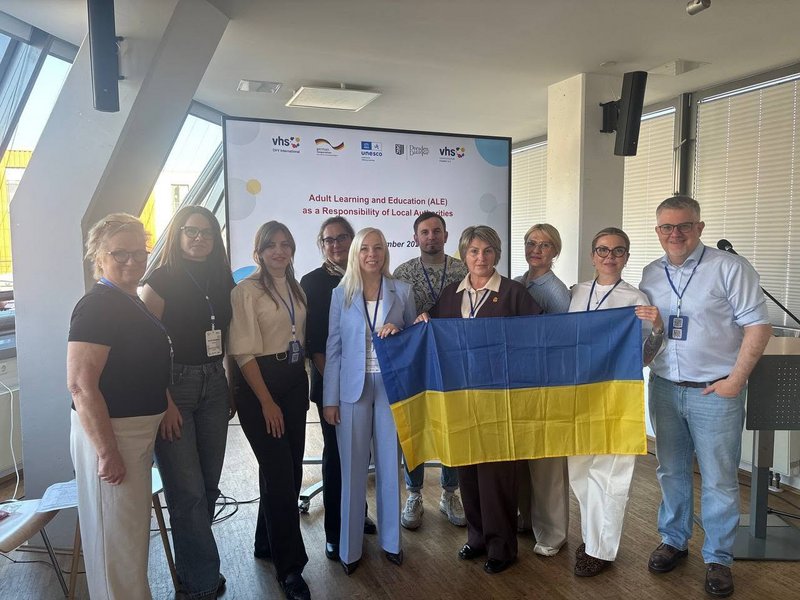
On 29–30 September 2026, the international conference “Adult Learning and Education (ALE) as a Responsibility of Local Authorities” took place in Dresden, Germany. Representatives of civil society and local authorities from different Ukrainian cities joined the professional exchange with colleagues from a number of countries, sharing their experience of cross-sectoral cooperation in developing adult learning and education.
The conference brought together representatives of local authorities, adult education institutions, civil society organisations, academia, and international organisations from Ukraine, Moldova, Georgia, Armenia, Bosnia and Herzegovina, Kosovo, Germany, and Poland. The event aimed to highlight the role of local authorities and their cooperation with non-governmental organisations in developing adult learning and education as an integral part of community development, active citizenship, and people’s adaptation to social and economic change. The conference was jointly organised by DVV International and the UNESCO Institute for Lifelong Learning (UIL), together with the City of Dresden.
Ukraine Shares Practical Experience of Local-Level Cooperation
A significant part of the programme was devoted to the exchange of good practices among cities and communities. The participants presented specific approaches to adult learning and education in their communities, as well as discussed the role of local authorities in creating accessible educational opportunities for residents.
In this session, Ukraine was represented by Viktoriia Furhalo, Programme Manager at the Lviv City Institute and Head of the Network of Education Centers "CE”. She explained the ecosystem of ALE in cities such as Lviv, Poltava, Sumy, Vinnytsia, Mykolaiv, and Voznesensk.
In particular, ALE ecosystems in these cities are based on cooperation among local authorities, civil society organisations, educational institutions, libraries and other municipal spaces, as well as support from external donors. The presentation also highlighted legislative acts that have either been developed or are currently under development and require support from local authorities. These include the Law of Ukraine “On Vocational Education”, which has already been adopted, and the draft Law “On Adult Education”, which is awaiting final consideration and a vote in the Verkhovna Rada of Ukraine.
In addition to compliance with and support for the relevant legislation, the effective development of adult education also requires strengthening cooperation with the UNESCO Institute for Lifelong Learning and taking into account recommendations from DVV International and other relevant organisations.
The Ukrainian presentation demonstrated to international partners how lifelong learning approaches are evolving in the Ukrainian urban context and how local initiatives can respond to the current needs of residents. These needs include addressing the consequences of the war through reskilling, supporting the reintegration of veterans into civilian life, and reducing the shortage of skilled workers needed for economic recovery.
For Ukraine, such an exchange of experience is particularly important in the context of transforming the adult education system, developing human capital, and rebuilding communities. The experience of Ukrainian cities demonstrates that adult learning can be a practical tool for supporting people during periods of change and strengthening the capacity of local communities.
From Exchange of Experience to Joint Action
The first day of the conference began with a discussion about which areas of ALE fall within the responsibility of local authorities. Participants also explored international practices from Germany and South Korea, as well as preliminary findings from a study on the social value of adult education centres in Georgia and Armenia.
A separate session focused on the exchange of local practices. In addition to the experience of Ukrainian cities, approaches were presented by the municipalities of Sisian (Armenia), Chișinău (Moldova), Ilijaš (Bosnia and Herzegovina), Peja (Kosovo), Hamburg, and Gdynia.
Following the presentations, participants discussed key conclusions and explored opportunities for applying the approaches presented in their own communities. In this way, the conference served not only as a platform for presenting good practices, but also as a space for professional dialogue and a search for joint solutions.
Dresden as an Example of a City Promoting Lifelong Learning
The second day of the conference focused on Dresden’s experience as a learning city. Dresden joined the UNESCO Global Network of Learning Cities in 2024. Most of the programme took place at the Dresden Municipal Adult Education Centre (Volkshochschule Dresden). In this space, in particular, participants learned more about the city’s approaches to the development of ALE.
Particular attention was paid to the Kulturpalast, one of the city’s key educational and cultural hubs. Participants learned about the work of the Dresden Philharmonic, the Central Library, and the COSMO Science Forum, as well as how different cultural and educational institutions can come together around the concept of a learning city.
This experience is particularly valuable for international exchange, as it demonstrates how the concept of lifelong learning can be integrated into broader urban development strategies.
International Exchange as a Resource for Developing Adult Education in Ukraine
Participation in the conference not only introduced Ukrainian partners to a range of interesting international practices, but also enabled them to present their own experience to the international professional community and gain new ideas on implementing lifelong learning approaches in their communities more effectively.
Olha Stefanyuk, Head of the “Adult Education Centre of the Poltava Region” project and a participant of the conference, emphasised on the importance of adult education in today’s world:
“The world is changing rapidly: scientific and technological progress, digitalisation, changes in the labour market, new forms of work, migration, and forced displacement are compelling many adults to change careers, acquire new competences, or effectively start their professional journey from scratch. Therefore, it is not enough to acquire a profession once and remain in it for the rest of one’s life. People need opportunities to learn continuously, develop, retrain, and remain active members of society. This is where non-formal adult education plays a crucial role. This is precisely why international events like these are so important. They provide an opportunity for representatives of different countries and cities to exchange experience, learn about successful practices, and understand how other communities are responding to labour market changes, digitalisation, and social challenges.”
She stressed that exchanging experience with representatives of different countries and cities, as well as civil society and public authorities, is extremely valuable at events of this level:
“We could not only share our own experience, but also hear from our colleagues, see different approaches, and bring these ideas back home. For me, this is the main value of such events: not only to exchange experience, but to gain the best ideas, adapt them to our own circumstances, and start implementing them in our communities. After all, lifelong learning gives people an opportunity not to lose themselves in times of change, to remain active, needed, and capable of developing alongside the world.”
Olha also emphasised the importance of synergy between civil society and local authorities:
“Adult education cannot exist solely thanks to individual enthusiasts or individual projects. We need to create an entire ecosystem in which the state, local government, educational institutions, civil society, and community residents themselves work together. My main conclusion is that the best results come not from a single course or institution, but from a lifelong learning ecosystem in which the state, local authorities, educational institutions, civil society, and citizens interact. In my view, this is the kind of system that is important to develop in Ukraine as well.”
Anna Babinska, Head of the NGO “Podillia-Socium Centre”, noted:
“Three principles of VHS Dresden’s work particularly resonated with me at the conference: strengthening personality, enabling participation, and promoting civil society. They are about how education, support, and people’s engagement can genuinely transform communities. This is undoubtedly a shared responsibility and a partnership involving civil society as well as government, business, and the media. That is why, together with representatives of Vinnytsia City Council, we are looking for joint solutions to expand access to learning opportunities for all adults. Such approaches are especially important today, when we are talking about integration, supporting people with diverse experiences and needs, active citizenship, and strong local communities.”
The conference was held as part of the Continental Exchange Project, launched by DVV International in 2022 to strengthen exchange, cooperation, and mutual learning among partners from countries in Eastern and South-Eastern Europe and the South Caucasus.
For DVV International and its partners, the development of adult learning and education at the local level remains an important area for building societies in which people have opportunities to learn throughout their lives, develop their competences, and actively participate in the life of their communities.